

Written by
Vertika Sarkari
Mind Mirror
After results arrive, career conversations can become a ranking exercise. High marks are treated as permission to take one path, while a disappointing result seems to close every door. Career guidance beyond marks starts by asking what a report card actually tells us, and what remains unknown.
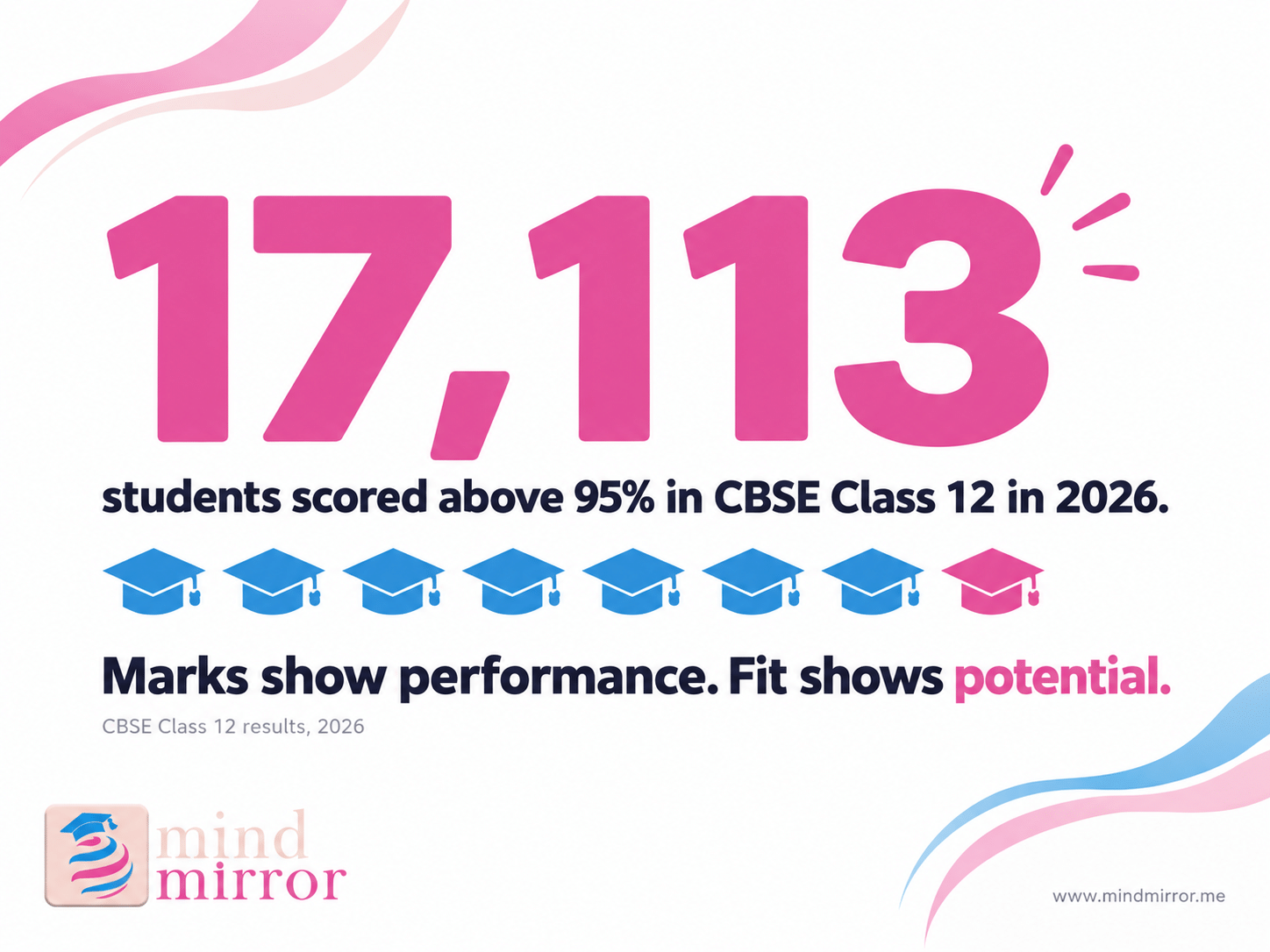
Marks matter. They can affect eligibility and show achievement within particular subjects and assessment conditions. But a percentage does not describe every skill a student has, the work they enjoy or the environments in which they want to learn.
Read the pattern, not only the total
Look across subjects and over time. Where did understanding improve with practice? Which topics remained interesting after the exam? Where did a student know the material but struggle to explain it under time pressure? These questions help separate different learning needs.
A lower result is a reason to investigate, rather than an instruction to abandon an interest. Equally, a high result does not create an obligation to pursue that subject professionally. A student can be capable in a subject without wanting its related work to become their daily routine.
Gather evidence that examinations miss
Make a small collection of work from the last six months. Include a written assignment, a practical project, an activity the student chose independently and feedback from someone who observed their work. Ask what each example shows.
- Did the student explain a difficult idea clearly?
- Did they organise a task and complete it reliably?
- Did they enjoy investigating why something failed?
- Did they listen carefully and help a group work together?
These observations do not automatically name a career. They suggest skills and activities worth exploring. Keep descriptions specific: “revised the experiment after testing” is more useful than “born scientist”.
Separate the subject from the occupation
Enjoying a school subject is a starting point. The related occupation may involve additional responsibilities that are not visible in class. A student attracted to writing, for example, could explore research, editing, interviewing, marketing or teaching, each with a different daily routine.
Speak with people who do the work. Ask what occupies most of their week, what beginners find difficult and which tasks surprised them. Combine those conversations with a small activity: interview someone, edit an article, explain a topic or analyse a problem.
Keep eligibility checks factual
When a course is shortlisted, read the institution’s current admission information. Record required subjects, minimum criteria, selection steps and deadlines separately. Do not rely on a general statement about a stream or assume one college’s rules apply everywhere.
If a preferred route is unavailable, compare genuine alternatives and what they lead to. The question is not simply whether another course sounds similar; it is whether its curriculum and entry requirements support the student’s goals.
A better conversation after results
Try this sequence: “What went well?”, “What was difficult?”, “What would you like to understand better?” and “What shall we investigate next?” Agree on one academic action and one exploration action. That keeps the discussion connected to progress instead of comparison.
Mind Mirror works with students and parents to bring academic evidence, interests, aptitude and real-world exploration into the same conversation. Start your career assessment with Mind Mirror to begin looking beyond the marksheet.